Zenmind Mental Health Presentation: A Template for Clear Communication
In today's demanding professional and personal environments, effectively communicating about mental health topics is both crucial and challenging. Whether you're a startup founder pitching a wellness app, a corporate trainer designing an internal workshop, or a creative agency presenting a campaign, the clarity and design of your presentation can significantly impact your message's reception. The Zenmind Mental Health Presentation template emerges as a specialized tool designed for this very niche. It is a PowerPoint template explicitly crafted for presentations related to mental wellness, psychology, mindfulness, and corporate well-being initiatives.
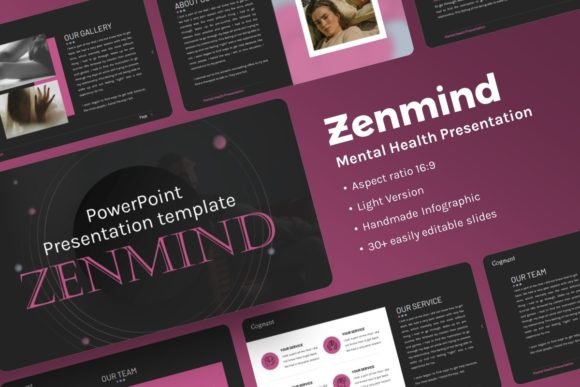
What makes it distinct is its foundational design philosophy. Unlike a generic business template, every element—from its color palette to its handcrafted infographics—is calibrated to convey calmness, clarity, and professionalism. The visual language avoids stark, aggressive corporate aesthetics, opting instead for softer tones and clean, spacious layouts that align with the sensitive nature of the subject matter. This intentional design choice positions the Zenmind Mental Health Presentation not just as a slide deck, but as a cohesive visual framework aimed at fostering engagement and understanding.
Comparing Presentation Tools for Sensitive Topics
When evaluating tools for creating a presentation on mental health, professionals typically consider several categories: fully generic PowerPoint templates, premium multipurpose templates from stock sites, custom-designed decks from a graphic artist, and specialized niche templates like Zenmind. Each path has its own tradeoffs.
Generic, free templates offer immediate cost savings but often require extensive modification. Their default imagery and graphics may not resonate with themes of mindfulness or resilience, potentially undermining the message's sincerity. Hiring a designer for a custom solution provides ultimate flexibility and brand alignment, but it involves a significant time and financial investment, which may not be feasible for a single presentation or a fast-moving startup.
Premium multipurpose templates from large marketplaces sit in the middle. They are professionally designed but are built for broad appeal—covering finance, technology, marketing, and more. Using one for a mental health presentation often means you must manually filter out incongruous elements: aggressive data charts, tech-centric icons, or high-energy visuals that don't suit the topic's tone. This customization work can be substantial.
The Zenmind Mental Health Presentation enters this landscape as a pre-curated option. Its distinction lies in its specificity. The template assumes your topic is mental health, so its master slides, placeholder suggestions, and illustrative infographics are already oriented toward concepts like stress cycles, support systems, mindfulness practices, and data on well-being. This provides a significant head start, reducing the time spent searching for appropriate visual metaphors or adapting unsuitable graphics.
Core Features and Practical Strengths
The Zenmind template package includes 30 slides, a documentation file, and uses the fonts Barlow and Karla. A key practical strength is its structure around master slides. This means global changes to fonts, colors, or layout elements can be applied efficiently across the entire deck, ensuring visual consistency. The inclusion of pixel-perfect illustrations and handcrafted infographics is particularly valuable. These are not standard PowerPoint SmartArt; they are custom-designed diagrams that can visually explain complex psychological concepts or wellness program frameworks.
All graphics are resizable and editable without losing quality, which offers flexibility. The picture placeholder functionality, with drag-and-drop ease, simplifies the process of inserting your own photography from recommended sources like Unsplash or Pexels. It’s important to note, as the provider states, that the demo images are for preview only and are not included. This means you must source your own imagery, which is a common practice with most templates, allowing you to tailor the visuals to your specific case studies or brand.
The file format is a standard PowerPoint .PPTX file, ensuring compatibility with both newer and older versions of the software, avoiding the friction that can come with less common file types. The choice of Barlow and Karla fonts is a thoughtful one; both are modern, clean, and highly readable sans-serif fonts that convey a contemporary yet approachable feel, which is ideal for this subject matter.
Evaluating Fit and Potential Limitations
The Zenmind Mental Health Presentation template is likely a strong fit for several realistic scenarios. A creative agency developing a pitch for a public health campaign would benefit from a deck that immediately communicates the right thematic tone to potential clients. A human resources professional building an annual well-being report for corporate leadership could use the infographics to present survey data and initiative outcomes clearly. A coach or consultant offering mindfulness workshops could leverage the template to create a polished, professional-looking client proposal or educational seminar.
However, its specialized nature also implies boundaries. If your presentation needs to cover mental health for only a small portion of its content, with the bulk focused on financial projections, technical architecture, or legal compliance, this template might become a constraint. You would be working against its inherent visual style, constantly adapting slides meant for one context to serve another. In such a blended presentation, a more neutral, multipurpose business template might offer greater overall flexibility.
A further consideration is the need for basic PowerPoint proficiency. While the template is designed for easy customization, it still requires a user comfortable with PowerPoint's master slide, shape formatting, and image placeholder features to truly harness its potential. Someone expecting a completely automated, zero-skill solution might find the need for manual image sourcing and text input to be a limitation. Conversely, for a user with intermediate skills, the template provides a powerful scaffold that dramatically speeds up the design process.
Decision Factors: When to Choose a Niche Template
Choosing between a niche template like Zenmind and a broader alternative hinges on a few key decision factors. The primary factor is topic centrality. How core is mental health or wellness to your presentation? If it is the absolute focus, the template’s pre-aligned design saves time and enhances message coherence. If it’s a secondary point, the benefits diminish.
Time and resource allocation is another critical factor. Do you have a designer’s budget and timeline? If not, a well-designed niche template is a cost-effective compromise between generic and custom. Brand alignment also matters. If your organization or personal brand already uses specific fonts, colors, or a very distinct visual identity that clashes with Zenmind’s calm aesthetic, extensive customization might negate the initial advantage. In that case, starting from a more neutral base might be simpler.
Finally, consider the audience’s expectations. Presenting to a board of directors might demand a very corporate, data-heavy style, even if the data is about wellness programs. Zenmind’s softer infographics might need bolstering with more traditional charts. Presenting to a community group or creative clients, however, the template’s approachable and thoughtful design could be perfectly aligned and even enhance your credibility on the topic.
Making an Informed Choice
Informed selection involves weighing these factors against your specific project. For a one-off, topic-specific presentation where you want to appear professional and knowledgeable without hiring a designer, the Zenmind Mental Health Presentation template represents a pragmatic, middle-ground solution. It offers a curated design foundation that reduces the risk of visual missteps on a sensitive topic.
However, if your work involves constantly creating presentations on vastly different subjects—from mental health to logistics to marketing—investing in a versatile multipurpose template suite, or developing strong in-house design skills, might offer better long-term value. Similarly, if your presentations are heavily reliant on complex, interactive data visualizations beyond static infographics, you may need to pair this template with additional tools or plugins.
The Zenmind template excels in its intended lane. It acknowledges that the medium is part of the message. When discussing mental health, a chaotic, visually aggressive slide deck can subtly contradict a message about calm and clarity. By providing a design environment already tuned for that message, it allows the presenter to focus more on content and delivery. It’s a tool that understands context, and for professionals who regularly communicate in that context, it can be a significant asset. For those whose needs are more eclectic or technically demanding, evaluating it as a specialist tool within a broader toolkit is the most realistic approach.