The Horizontal Loop: Visualizing Cyclical Processes in Modern Design
In our increasingly digital and interconnected world, the ability to clearly communicate complex, recurring processes is paramount. From software development cycles to weekly team workflows, the concept of the loop—a continuous, often improving, sequence of events—is foundational. This is where the power of visual iconography comes into play, and specifically, sets like the Horizontal Svg Loop Concept Icon Set offer a specialized toolkit for designers, educators, and professionals.
Understanding the Loop as a Universal Concept
A loop represents more than just repetition; it symbolizes iteration, feedback, and cyclical progression. In software architecture, it’s the agile development cycle. In business, it’s the regular schedule of meetings and reporting. In education, especially in online classes for abstract subjects like software architecture, it’s the pedagogical journey from theory to practice and back again. Visualizing these loops horizontally, rather than vertically or circularly, often aligns with our natural reading flow and screen layouts, making the progression feel logical and timeline-oriented.
Characteristics of Effective Loop Visualizations
When depicting these processes, certain design characteristics enhance clarity. An isolated outline drawing with an editable stroke, as found in professional icon sets, allows for seamless integration into various media without background clutter. The use of a clean, readable font like Arial for any accompanying text ensures legibility across platforms. The essence is to create a thin line illustration that is abstract enough to represent an idea but precise enough to be immediately understood. The Horizontal Loop Concept Icon Set typically embodies these traits: clarity, flexibility, and semantic precision.
Practical Applications Across Domains
The utility of such a focused icon set is vast. Consider the challenge of explaining a sophisticated software architecture pattern in an online class. A static diagram might show components, but a horizontal loop icon can animate the process of data flow, request handling, and response cycles between those components, making the abstract idea tangible. Similarly, in project management, a horizontal loop can illustrate the recurring stages of planning, execution, review, and adjustment, providing a clear visual for a regular schedule.
Enhancing Colleagues Communication
One of the most significant real-world applications is in internal communication. Complex workflows or feedback cycles can be difficult to convey in emails or verbal briefings. A simple, well-designed horizontal loop icon inserted into a presentation, brochure infographic template, or even a mobile app screen page can serve as a universal anchor point. It tells every team member, regardless of their department, that this part of the discussion involves a repeating, interconnected process. This visual shorthand reduces cognitive load and aligns understanding, fostering more effective collaboration.
The Advantage of Editable, Multi-Format Assets
Professionals don’t work in a single medium. A marketing manager might need an icon for a JPEG social media post, a developer for a PNG in a web application, and a print designer for an EPS file in a physical brochure. The value of a comprehensive offering—like one providing product file formats EPS, JPEG, AI on white background SVG, PNG on transparent background—is immense. It means one asset, such as a horizontal loop icon from a curated set, can be adapted for every need without quality loss or stylistic mismatch. The editable stroke feature is particularly crucial; it allows designers to match the icon’s weight and style to their existing brand guidelines or project aesthetics, ensuring cohesion.
Integrating Icons into Creative and Educational Workflows
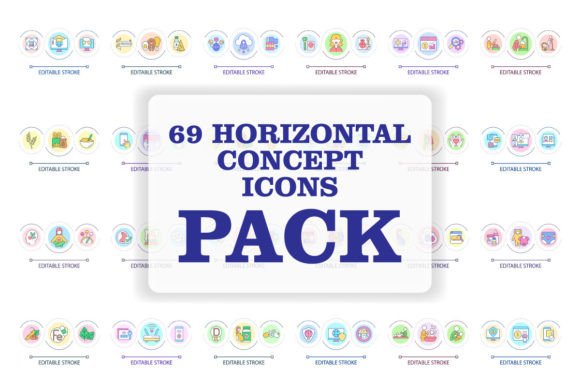
For creators and educators, these icons become building blocks. A lecturer building an online course module on cyclical economic models can use the icons to create a visual narrative alongside text. A UI/UX designer prototyping a productivity app can use loop icons to represent recurring tasks or periodic notifications within the mobile app screen pages. The workflow starts with selecting the right icon from a broad set—the mention of 69 editable stroke concept icons indicates a library with ample variety for different loop contexts (communication loops, development loops, learning loops). Then, it involves customization via the editable stroke to fit the theme, and finally, export in the required format for implementation.
Considerations for Selection and Use
While such resources are powerful, their effective use requires consideration. First, semantic accuracy: the chosen icon must genuinely represent a loop concept and not be misinterpreted as a linear progression or a closed system. Second, consistency: if using multiple icons from a fonts list or a broader set, ensure stylistic harmony in line weight and detail level. Third, accessibility: when used in digital formats, ensure icons are accompanied by descriptive text or alt tags for screen readers. The goal is always to enhance understanding, not replace necessary textual explanation.
The Broader Ecosystem of Digital Design Resources
Sets like the Horizontal Svg Loop Concept Icon Set are often part of a larger creative ecosystem. Studios that create icons, brochure infographic templates, mobile app screen pages and more operate on a model of continuous support and expansion. The promise of new topics and discounts every week speaks to an understanding that designers’ needs evolve. For a business owner or a freelance creator, subscribing to such a service—be it BSD Studio or similar—means staying updated with fresh visual tools that can keep communication materials modern and effective. This subscription model, rather than one-off purchases, aligns with the ongoing, looping nature of creative work itself.
Real-World Observations and Future Relevance
Observing modern digital interfaces, from complex enterprise software to consumer apps, reveals the pervasive use of loop and cycle imagery. They guide users, explain processes, and simplify onboarding. As remote work and online education solidify their place, the demand for clear visual communication of schedules, architectures, and collaborative cycles will only grow. A well-crafted, horizontal loop icon set, with its emphasis on editable strokes and multi-format readiness, is not just a collection of graphics; it’s a functional toolkit for bridging the gap between abstract idea and practical understanding. It empowers the educator to demystify software architecture, the manager to clarify a regular schedule, and the team to strengthen colleagues communication, ultimately making intricate cyclical processes accessible to a broad audience.