Mastering Communication in Critical Moments with Professional Design Resources
When an unforeseen event disrupts normal operations, the clarity and speed of your response are paramount. This period, often termed a crisis, demands not only decisive action but also effective communication. The tools used to convey information—to employees, stakeholders, clients, and the public—can significantly influence the outcome. In this context, professionally designed materials are not mere aesthetics; they become functional instruments of stability and reassurance.
The Role of Visual Design in Crisis Communication
Imagine receiving a hastily written, poorly formatted memo during a serious business disruption. The visual chaos amplifies the sense of disorder. Conversely, a clear, well-structured document projects control and competence. Visual design in crisis communication serves several critical functions. It organizes complex information into digestible segments, establishes a tone of authority and transparency, and ensures consistency across all touchpoints. This consistency helps build trust, as recipients recognize a unified voice and approach.
A key element of this visual toolkit is the brochure or leaflet. Unlike lengthy reports, brochures are designed for rapid dissemination and comprehension. They can outline key steps, provide contact protocols, summarize policy changes, or explain a situation to a broader audience. Their success hinges on layout, typography, and iconography.
Why Specific Design Resources Matter
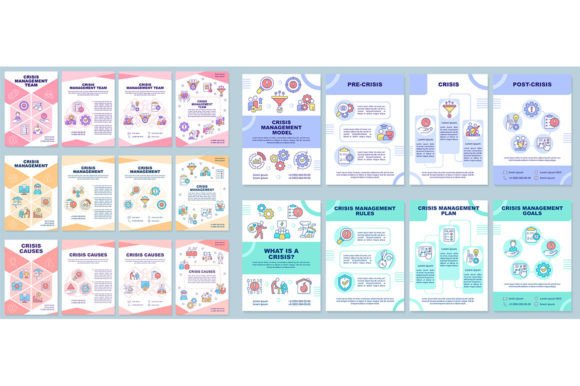
Generic templates often fall short under pressure. Resources tailored for crisis scenarios anticipate the need for specific content structures. For instance, a Crisis Management Brochure Template Set typically includes layouts for incident response flowcharts, communication chain diagrams, post-event analysis summaries, and public statement frameworks. These are pre-formatted for the kind of information that must be communicated urgently.
Using established, legible typefaces like Arial Black and Myriad Pro Regular, as mentioned in available design packs, ensures readability even when documents are viewed digitally on varied devices or printed quickly. Arial Black provides strong, clear headers that command attention, while Myriad Pro Regular offers a clean, approachable body text font.
Anatomy of an Effective Crisis Communication Template
Examining a typical template set reveals components engineered for utility.
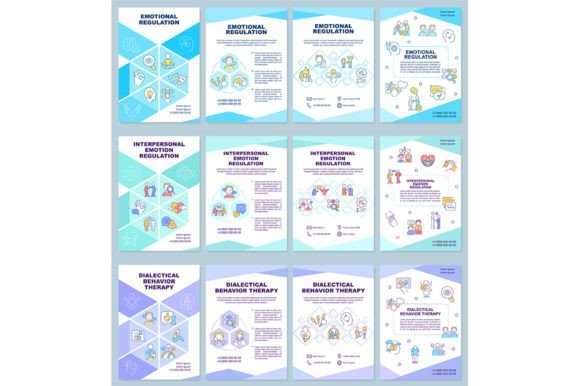
- Leaflet Design with Linear Icons: Linear icons are simplified, minimalist graphic representations. In a crisis brochure, icons for "Emergency Contact," "First Steps," "Assessment," and "Recovery" allow readers to navigate the document visually, understanding sections instantly without relying solely on text. This speeds up comprehension when time is critical.
- Editable Vector Layouts: The value of editable vector files (such as EPS or AI) lies in their adaptability. A crisis is unique; your communication must be specific. Vector formats allow organizations to modify every element—text, colors, shapes, icons—without loss of quality, ensuring the final brochure aligns perfectly with the actual situation and the company's branding, even under tight deadlines.
- Multi-Format Availability: Having the same design available in various file formats like JPEG for quick inclusion in emails or presentations, SVG and PNG for use on websites and digital apps, and EPS for high-quality print production, means the core message remains visually consistent across all media channels. This unified front is vital during a crisis.
These sets often contain multiple layout variations—perhaps four or five distinct brochure templates within a zip file. One layout might be optimized for an internal procedural guide, another for a public-facing fact sheet, and another for an annual report section that details the crisis response retrospectively. This variety provides a ready-made starting point for different phases and audiences of the management process.
From Immediate Response to Long-Term Reporting
The application of these templates spans the timeline of an event. Immediately, a leaflet can be deployed to outline the response plan for staff. In the following days, a more detailed brochure might be used to update stakeholders on progress. Finally, in the aftermath, a polished template can be utilized to create the crisis management section of an annual report, presenting a coherent narrative of the event, the actions taken, and the lessons learned. This demonstrates accountability and reinforces institutional memory.
Beyond brochures, studios that create such resources often expand into related design needs. The mention of mobile app screen pages, for instance, highlights the digital dimension. During a crisis, many turn to official apps or websites for updates. Having pre-designed screen layouts that maintain visual continuity with printed materials helps manage the digital communication flow efficiently.
Considerations for Selecting and Using Design Templates
While a well-designed template set offers immense practical value, its effectiveness depends on thoughtful selection and use.
Firstly, the template must be truly editable. If a file is merely a static image, it becomes a constraint rather than a tool. Ensuring the set includes files for professional design software (like Adobe Illustrator AI files) allows your team or designer to make necessary alterations. Secondly, the design should be professional yet not overly stylized. During a crisis, the message is primary; the design should enhance, not distract. Clean, modern templates with a focus on information hierarchy are most effective.
Another consideration is breadth of use. A single template might suffice for one event, but a set covering different scenarios—operational, financial, reputational—provides a more robust library. This aligns with the offer of new topics and discounts every week from some design studios, suggesting an evolving resource library that can grow with an organization's preparedness needs.
Integrating Templates into Preparedness Plans
The wisest approach is to integrate these design resources into your crisis preparedness plan before an event occurs. This means evaluating template sets, selecting those that fit your organizational tone and likely scenarios, and familiarizing relevant personnel with how to edit and deploy them. Having the templates on hand, with approved fonts and color schemes already set, can save crucial hours when a crisis emerges. Subscription models to studios, like subscribing to BSD Studio to be updated, can ensure access to the latest templates and icons, keeping your communication tools current.
It is also important to remember that templates are a foundation. They ensure visual coherence and speed up production, but they must be filled with accurate, timely, and honest content. The design supports the message, but the message itself—crafted by management, legal, and communication experts—is the core.
The Broader Impact on Perception and Recovery
Ultimately, the quality of external and internal communication during a challenging period leaves a lasting impression. A haphazard, poorly presented response can exacerbate damage to trust and reputation. A coherent, professionally presented communication strategy, supported by appropriate design tools, signals that the organization is competent, organized, and taking the matter seriously. This can mitigate secondary reputational harm and aid in the overall recovery process.
Observations from various fields show that organizations with pre-prepared communication frameworks, including visual elements, often navigate crises with less internal confusion and more external confidence. The brochure, leaflet, or digital screen becomes a tangible symbol of the organization's control and commitment to transparency.
In summary, managing a crisis involves managing information. The Crisis Management Brochure Template Set and similar design resources are specialized instruments for this task. They translate procedural steps and key messages into accessible, authoritative, and adaptable visual formats. By prioritizing not only what is said but also how it is presented, organizations can bolster their response, maintain trust, and document their journey through the event with clarity and professionalism.